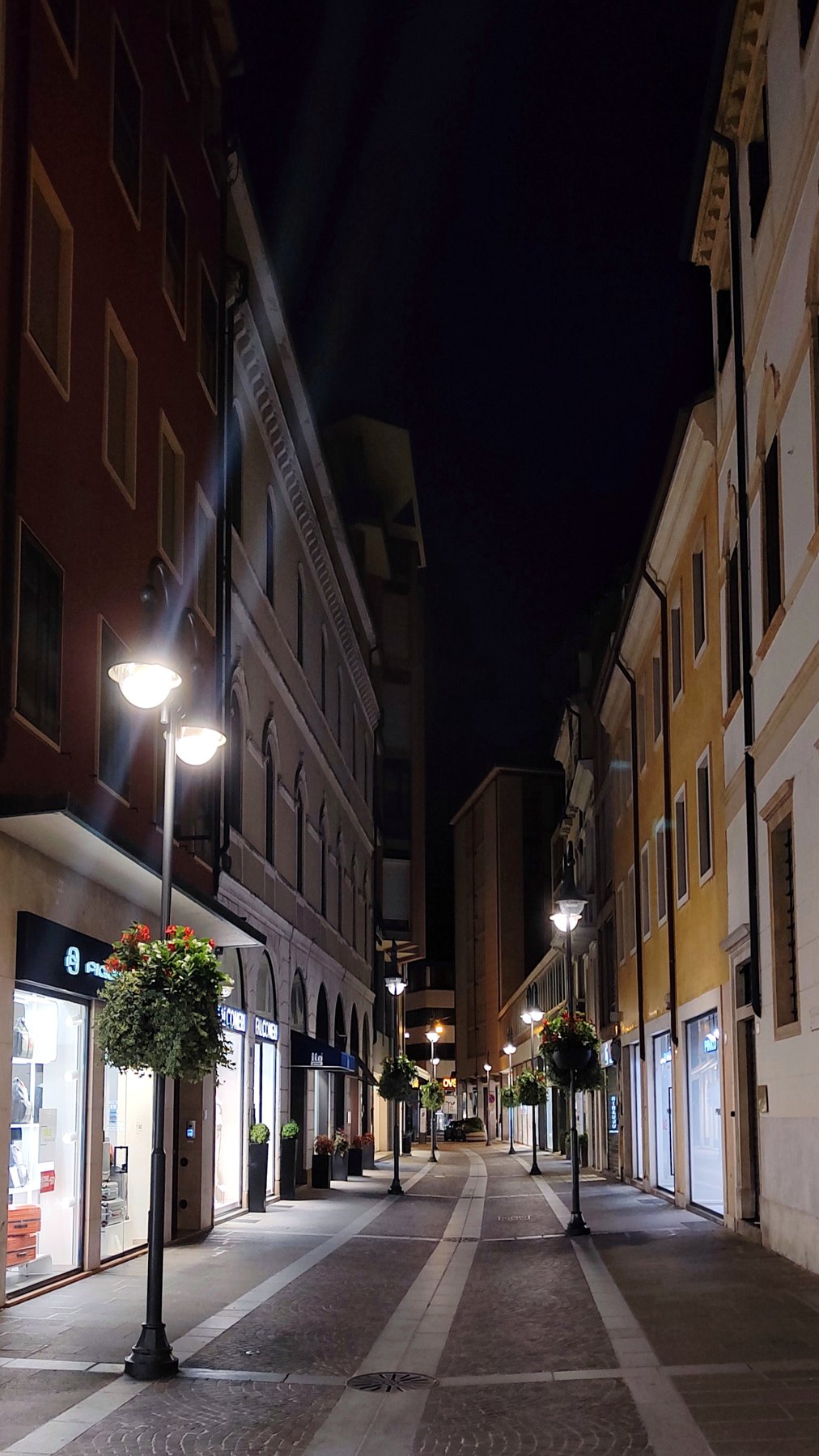
A street at night rarely consists of uniformly little light. Bright shop windows meet dark doorways, coloured signs meet changing vehicle lights. First decide what should carry the photograph: a still building, a person in a pool of light or a movement trail. That determines whether you need a long supported exposure or a short handheld one.
Use a pool of light
For moving people, waiting for a well-lit section is often more useful than trying to photograph the darkest part of the street. A shop window can illuminate face and clothing. Choose the framing first and watch for someone entering that area. Keep walkways clear and remain in a safe position.
Start with a time appropriate to movement, such as 1/250 second as a test for a brisk walk. Open the aperture as far as the intended depth of field permits and raise ISO when needed. Stabilization helps your hand movement, not the person’s step. Check focus on a contrast feature at the correct distance.
Do not blindly protect every bright sign
A sign can clip individual colour channels long before the rest of the picture looks bright. If its lettering matters, inspect it at magnification and, when useful, with an RGB histogram. If it is merely a small accent, a limited bright area may be acceptable. Strongly underexposing the whole street for one tiny lamp often harms the main subject.
Mixed light does not need to become neutral everywhere. A warm cafe and cool sky can describe the scene coherently. Choose white balance that keeps important skin or object colours plausible and let other sources retain their character. A fixed value helps related images avoid colour shifts with every reframing.
Use long exposure deliberately
For a still city view, a tripod and self-timer can permit lower ISO and longer exposures. Passing vehicles become light trails, while people may smear or partly disappear. Choose trail length for the composition. A trail obscuring the main subject does not improve merely because the exposure becomes longer.
After capture, check fixed details for shake and lights for distracting reflections. Dirty front glass or an extra filter can intensify bright ghost images. Shift the angle slightly if necessary. Under LED lighting, also test for bands, especially with electronic shutter. This separates lighting design, movement and technical artifacts clearly.