If a straight table edge looks curved in a photograph, lens distortion may be responsible. This differs from holding the camera crooked or pointing it upwards at a building. Choosing a suitable correction begins with identifying the cause. Trying to repair every unusual proportion with one slider can improve straight lines while stretching important subject parts unnaturally.
Barrel, pincushion and straight converging lines
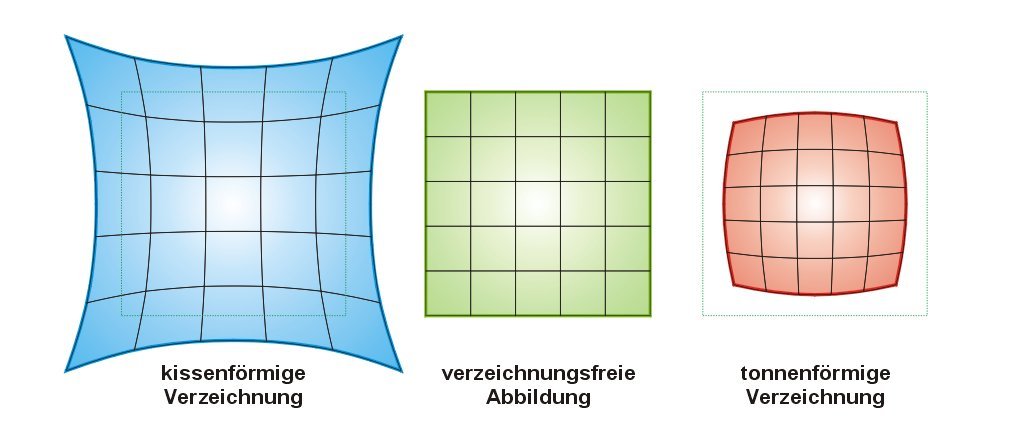
Barrel distortion bows straight lines outwards; pincushion distortion pulls them inwards. Some lenses show more complex combinations. Lines near the frame edges make this easiest to recognize. A landscape without conspicuous straight lines can contain the same distortion without it becoming distracting in the finished photograph.
Converging building edges, by contrast, often remain straight but meet towards the top. This results from perspective when the camera tilts upwards. A lens profile cannot automatically treat that convergence as the same fault. Align the camera appropriately during capture and use a separate perspective adjustment afterwards if needed.
Use profile corrections deliberately
Many cameras and RAW applications contain correction profiles for particular lenses. Check whether a correction is already applied automatically before adding manual adjustments. A second strong correction can bend lines in the opposite direction. Inspect several areas rather than one edge in the centre alone.
Geometric corrections move and interpolate pixels. They can create empty border areas that disappear through cropping. Leave some space around important details when photographing architecture or products. A tightly clipped roof edge or handle cannot reliably be recovered after correction. The preview before export should show the final framing.
Not every stretched edge is a defect
People near the edge of a very wide-angle photograph may look stretched even when straight lines are rendered correctly. This relates to projecting a wide angle of view onto a flat surface. Place important faces nearer the centre or choose more distance and a narrower angle. A technical profile cannot replace that compositional decision. For a group, the outer people’s positions therefore matter before you press the shutter.