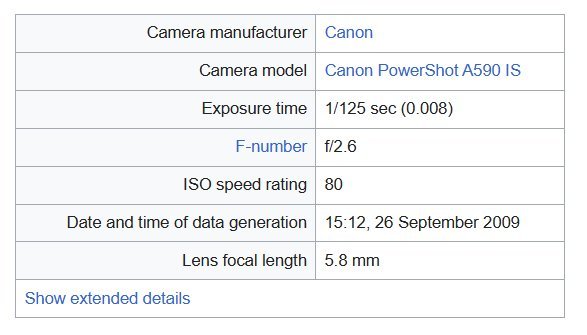
EXIF data can contain shutter speed, aperture, ISO, focal length and camera model. It helps when investigating a shaken image or identifying settings used for a successful sequence. It does not replace looking at the subject. Two photographs with identical numbers can look completely different under different light, distance or movement.
Read the useful fields first
For a sharpness problem, start with exposure time and focal length. A long exposure with tight telephoto framing makes camera movement plausible but does not prove it. Then check aperture: a very wide setting can explain shallow depth of field. ISO helps you assess lighting conditions and the possible trade-off between noise and movement.
Pay attention to units and labels. Actual focal length is not always the same as an additionally displayed full-frame equivalent. Capture time may come from an incorrectly set camera clock. Stored orientation explains why software rotates an image. Devices do not all write the same fields, and applications do not display every manufacturer-specific item.
Compare similar photographs
Select several frames from the same situation and look for a pattern. Were soft frames mostly taken at longer exposures? Did automatic settings raise ISO or change aperture while zooming? Comparison within a sequence is usually more revealing than copying a stranger’s photograph settings. The numbers indicate conditions; they are not universal recipes.
Note extra observations that EXIF does not reliably record: supported camera, moving person, window light from the left or strong wind. These short notes make later evaluation much clearer. With manual or adapted lenses, focal length and aperture may be missing or incomplete. Add them separately if appropriate without presenting estimated values as certain measurements.
Inspect before sharing
Editing and export software can remove, add or change metadata. Missing EXIF therefore does not prove a particular capture method. Before publishing, also check for location coordinates or other information you do not want to share. Export an appropriate copy and inspect that file again. Keep the original with its capture data for your own analysis.