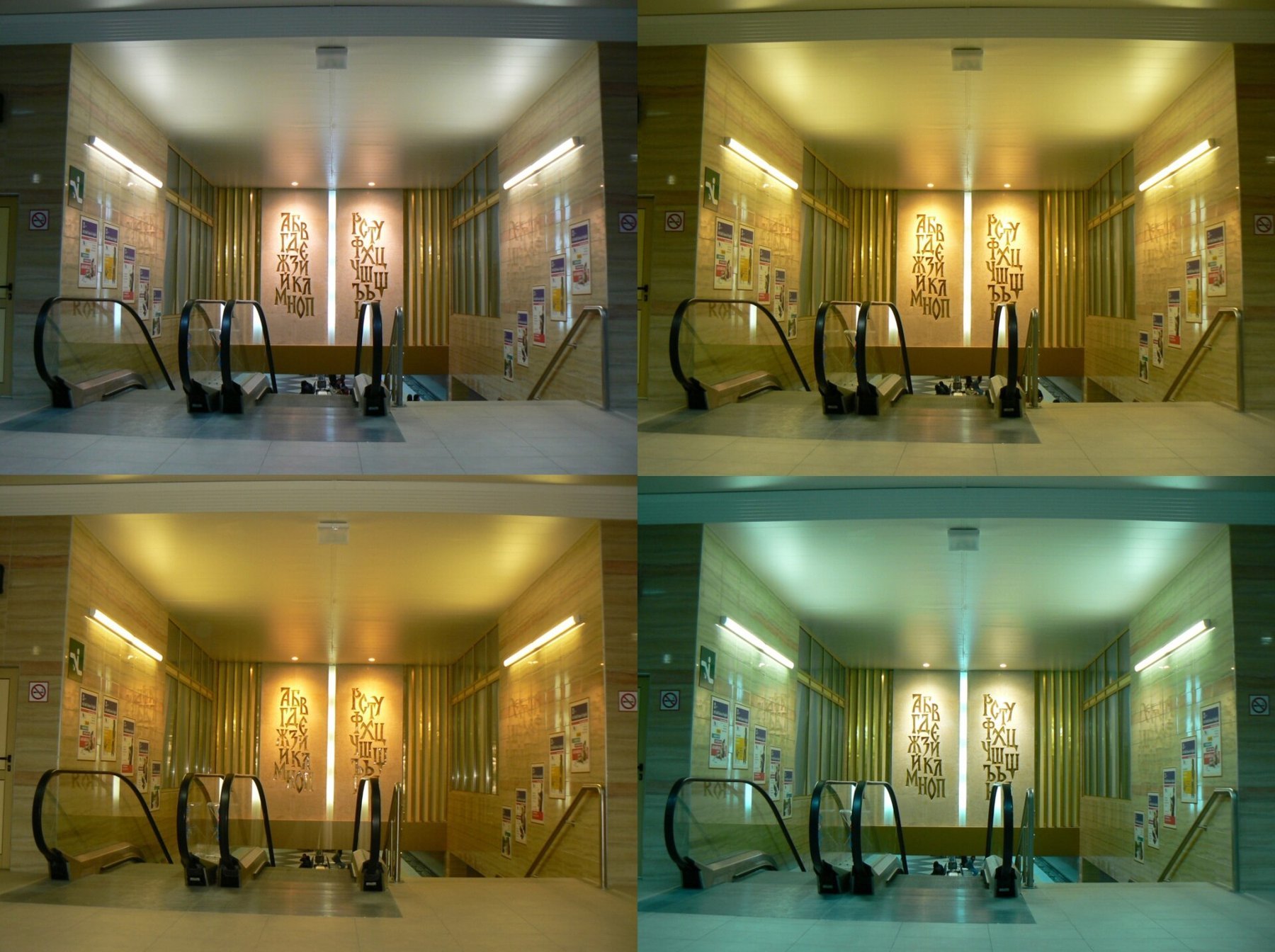
Someone sits beside a window while a warm ceiling lamp remains on. The side of the face near the window receives different light from the other side. Warming the whole image may correct one side while turning the other orange. Mixed light is therefore not simply about finding the right Kelvin value; it also concerns where the light sources fall.
Choose a dominant light source
Decide which source should shape the important subject. For a window portrait, turn off the ceiling lamp or move the person nearer the window so daylight dominates more strongly. Check the background too: a warm lamp there can contribute atmosphere as long as its light does not spill distractingly across the face.
If you cannot change the sources, find a position where one kind of light illuminates the face as evenly as possible. A small turn may achieve more than a large editing correction. Also inspect coloured walls and curtains that tint reflected light. White balance does not remove a surface’s colour from the light it reflects.
Neutral reference and a fixed setting
A suitable neutral grey card can provide a reference. Place it where the subject is and under the same illumination, not nearer the camera in different light. Avoid glare and overexposure on the card. The camera can derive a custom white balance, or a reference frame can guide later RAW processing.
Automatic white balance may shift between similar photographs when framing or the proportion of a coloured surface changes. For a series under unchanged light, a fixed value often gives more consistent results. It does not need to neutralize every warm source completely. Deliberately retained warmth can suit the scene while skin and important object colours remain plausible.
A face between window and table lamp
If one side of a face receives window light and the other a warm table lamp, the sides have different colours. Global white balance shifts both together. Neutralize the window side and the lamp side stays warm; neutralize the lamp and the window side may become distinctly blue. One global correction cannot treat two differently illuminated areas separately and make both neutral.
Decide the intended result before shooting. For an even portrait, switch off the lamp or move the person so that one source mainly reaches the face. If the warm lamp belongs to the atmosphere, allow a visible colour difference. A neutral card helps only with light that actually reaches it. A card beside the window does not automatically describe illumination across the room.
For a sequence, photograph a new reference after each substantial lighting change. This helps when you later cannot remember whether a wall was beige or merely warmly illuminated. Local masks can balance individual areas, but transitions across hair, skin and shiny objects need careful checking. Cleaner mixed lighting at capture often saves more work than a complicated later repair.
Limits of later correction
RAW provides more latitude for a new white-balance decision than a processed JPEG. Nevertheless, a face lit in two different colours remains a local problem. Masks can correct individual areas, but their transitions need careful inspection. Some artificial sources reproduce particular colours weakly; a temperature slider cannot reliably reconstruct missing colour information. Uniform lighting is therefore a better starting point for colour-critical product photographs.